
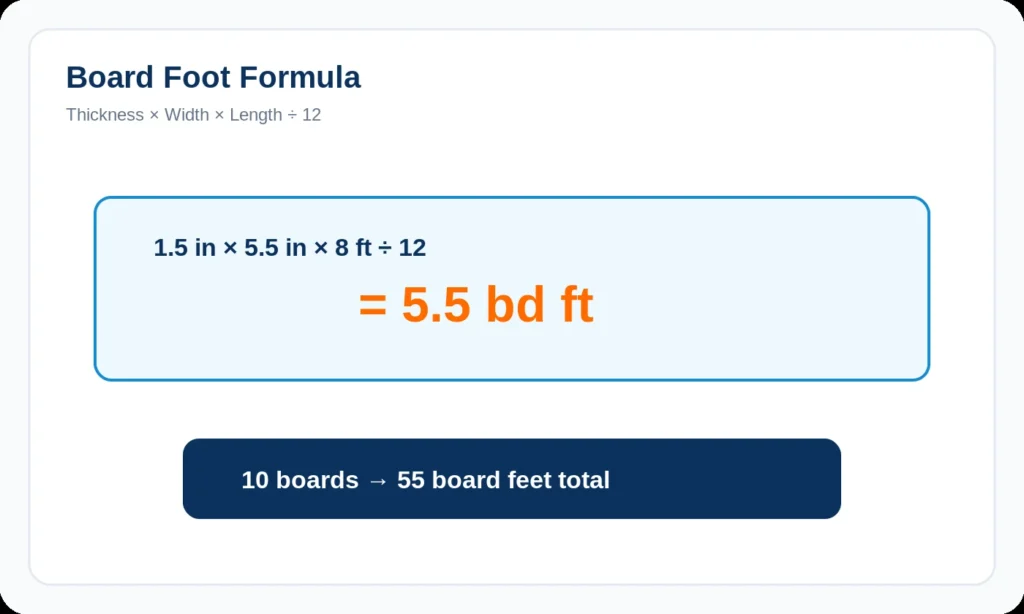
Board feet are a volume measure used for lumber. Once thickness, width, length and quantity are known, the math is straightforward—but accurate estimating still depends on using the correct dimensions and understanding whether a seller is quoting nominal, surfaced or actual sizes.
What is a board foot?
One board foot represents a piece of wood 1 inch thick, 12 inches wide and 12 inches long, or any equivalent volume. The U.S. Forest Service describes a board foot as a unit of wood measuring 12 inches by 12 inches by 1 inch.
The standard board-foot formula
When thickness and width are measured in inches and length is measured in feet:
For multiple identical boards:
- 1.5 × 5.5 × 8 ÷ 12 = 5.5 board feet per board.
- 5.5 × 10 = 55 board feet total.
Nominal size vs actual size
Nominal lumber dimensions are size names, not always the final surfaced dimensions. NIST’s weights-and-measures guidance distinguishes nominal and minimum/actual dimensions; for example, a nominal 2 × 4 is commonly surfaced to about 1.5 × 3.5 inches.
For physical volume, weight calculations and cut planning, use the actual measured dimensions when that is what you need to know. For purchasing hardwood sold by board foot, use the seller’s stated measurement method because trade practices can differ by product and stage of surfacing.
Board feet from inches only
If thickness, width and length are all in inches, use:
Board feet from metric dimensions
Metric lumber can be converted to cubic meters first, then to board feet, or the dimensions can be converted into inches and feet. For project planning, a calculator avoids repeated unit conversions and keeps the relationship transparent.
Use the Board Foot Calculator for mixed US/metric inputs and multiple line items.
Calculating several different board sizes
A project rarely uses one board size only. Calculate each line item separately, then add the totals.
| Board size | Qty | Board feet each | Total |
|---|---|---|---|
| 1.5 × 5.5 × 8 ft | 10 | 5.5 | 55.0 bd ft |
| 1.5 × 7.25 × 10 ft | 6 | 9.06 | 54.38 bd ft |
| 0.75 × 11.25 × 6 ft | 4 | 4.22 | 16.88 bd ft |
| Combined | 126.26 bd ft | ||
Convert board feet to cubic feet
Because one board foot equals 144 cubic inches and one cubic foot equals 1,728 cubic inches:
1 board foot = 1/12 cubic foot
So 60 board feet represents 5 cubic feet of nominal volume.
Estimate lumber cost from board feet
If a seller quotes a price per board foot:
Keep waste or purchasing allowance separate so you can see the base quantity and the extra quantity clearly.
Board feet are not the same as linear feet
Linear feet measure length only. Board feet measure volume. Eight linear feet of a 1 × 4 and eight linear feet of a 2 × 12 are the same length but very different volumes.
Board feet vs plywood sheets
Plywood is normally planned by panel area and sheet layout rather than by board feet. If your project uses sheet goods, use the Plywood Calculator instead.
Board feet vs lumber weight
Board feet tell you volume, not weight. Weight depends on density and moisture condition in addition to volume. Use the Lumber Weight Calculator when load or handling weight matters.
Common board-foot mistakes
- Using length in inches in the formula that expects feet.
- Confusing nominal size names with actual surfaced dimensions.
- Forgetting to multiply by quantity.
- Treating board feet as linear feet.
- Using board-foot volume to infer structural capacity.
- Applying one seller’s measurement convention to another without checking how the lumber is quoted.
FAQ
How many board feet are in a 2 × 4 × 8?
Using nominal dimensions, 2 × 4 × 8 ÷ 12 = about 5.33 board feet. Using actual surfaced dimensions such as 1.5 × 3.5 × 8 gives 3.5 board feet of physical volume. Which figure is appropriate depends on what you are measuring and how the lumber is sold.
How many board feet are in one cubic foot?
There are 12 board feet in one cubic foot because a board foot is one-twelfth of a cubic foot.
Do I use nominal or actual lumber dimensions?
Use dimensions that match the purpose of the calculation. For physical volume or weight, actual measured dimensions are usually appropriate. For lumber sold by board foot, follow the seller’s stated measurement method.
Can board feet tell me how much a board weighs?
Not by itself. Weight also requires a density assumption, and wood density varies with species and moisture condition.
Related lumber tools
Sources and methodology
BuildCalcForge uses the standard geometric definition of a board foot and transparent unit conversions. Reference sources include U.S. Forest Service definitions of board-foot volume and current NIST weights-and-measures guidance distinguishing nominal and surfaced lumber dimensions.