
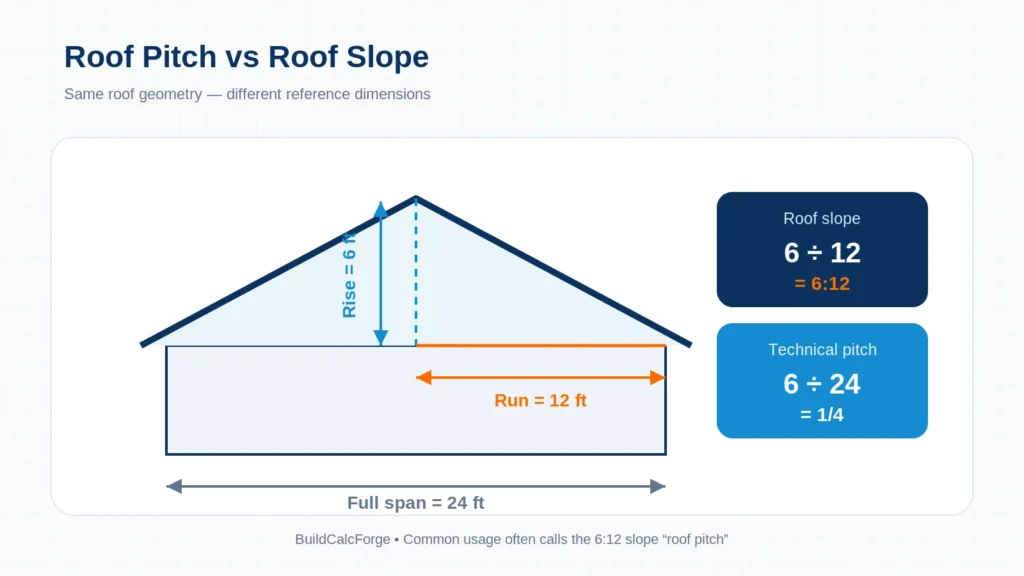
Roof pitch and roof slope are often used as if they mean exactly the same thing, especially in residential estimating and homeowner conversations. In strict technical usage, however, they can describe two different ratios: slope compares rise with horizontal run, while pitch compares rise with the full roof span.
Roof slope: rise divided by horizontal run
Roof slope measures how much a roof rises vertically relative to a horizontal run. The National Roofing Contractors Association defines roof slope as the angle a roof surface makes with the horizontal and notes that it may be expressed as a rise-to-run ratio such as 4:12 or as an angle in degrees.
A 6:12 slope means the roof rises 6 units for every 12 units of horizontal run. The units cancel as long as both measurements use the same unit.
Slope formula
Roof slope
slope ratio = rise ÷ run
x:12 value = (rise ÷ run) × 12
Roof pitch: rise divided by span in stricter terminology
GAF’s steep-slope field guide distinguishes slope as the ratio of roof rise to horizontal run and pitch as the ratio of roof rise to the roof span. For a symmetrical gable roof, the run of one side is half the total span, which is why the numerical pitch ratio differs from the familiar x:12 slope value.
Example: the same roof described both ways
Imagine a symmetrical gable roof with:
- 6 ft rise
- 12 ft horizontal run from wall to ridge
- 24 ft full span from wall to wall
Its roof slope is:
6 ÷ 12 = 0.5, which converts to 6:12.
Using the stricter rise-to-span pitch definition:
6 ÷ 24 = 1/4, so the technical pitch is 1/4.
Both describe the same roof geometry, but they use different horizontal reference dimensions.
Why people still say “6:12 roof pitch”
Common residential language has made “roof pitch” a familiar label for x:12 roof steepness. Search results, calculators, contractors, plans and homeowners may therefore use “pitch” where a technical roofing reference would use “slope.”
For BuildCalcForge, clarity is more useful than arguing over the label. Our Roof Pitch Calculator treats an entry such as 6:12 as a rise-over-run x:12 value, then converts it to angle, percent slope and slope factor. The page labels the geometry so users can see exactly what is being calculated.
Roof slope vs roof angle
Slope is a ratio; angle is measured in degrees. They are related but are not interchangeable numbers.
For a rise of 6 and run of 12:
angle = arctan(6 ÷ 12) ≈ 26.57°
So a 6:12 slope corresponds to an angle of about 26.57 degrees.
Roof slope vs percent slope
Percent slope expresses the same rise/run relationship as a percentage:
percent slope = (rise ÷ run) × 100
A 6:12 slope equals 50%. A 3:12 slope equals 25%.
Roof slope vs slope factor
The slope factor converts a horizontal plan length into the corresponding simplified sloped length:
slope factor = √(1 + (rise ÷ run)²)
For 6:12, the factor is approximately 1.118. A 12 ft horizontal run therefore corresponds to about 13.42 ft of straight-line sloped geometry before project-specific cut or assembly details are considered.
Does the terminology affect roof-area calculations?
The label does not change the math as long as the calculator knows which ratio you are supplying. Roof-area calculations need the actual rise/run slope relationship or its equivalent angle/slope factor.
That is why the Roof Area Calculator works from an x:12 rise-over-run value rather than a rise-to-full-span pitch fraction.
Does the terminology affect rafter calculations?
Again, the important part is the geometry. A common-rafter triangle is based on a horizontal run and a vertical rise. If someone says “6:12 pitch,” the BuildCalcForge rafter tools interpret that as 6 units of rise for 12 units of horizontal run.
Use the Rafter Length Calculator when you know the roof run or full building span and need straight-line common-rafter geometry.
What does NRCA mean by steep-slope roofing?
NRCA describes steep-slope roof systems as a category that generally includes water-shedding roof coverings installed on slopes exceeding 3:12. That classification should not be treated as a universal minimum slope for every roofing product. Minimum slopes and application requirements vary by roofing system, product instructions, code requirements and project conditions.
In other words, knowing the slope is necessary, but slope alone does not tell you whether a specific shingle, tile, metal panel, membrane or other roof covering is appropriate.
Which term should I use?
Use the term that matches your audience, then define it. For homeowner-facing planning, “roof pitch” is widely understood as an x:12 value. For technical documentation, specifications or manufacturer instructions, preserve the terminology used by that source.
When exchanging measurements with a contractor, designer or supplier, the clearest approach is to state the actual ratio—for example, “6 inches of rise per 12 inches of horizontal run”—rather than relying on the word pitch or slope alone.
Roof pitch vs roof slope FAQ
Are roof pitch and roof slope the same thing?
They are often used interchangeably in everyday construction language. In stricter terminology, slope is rise/run while pitch may refer to rise/full span.
Is 6:12 a pitch or a slope?
Technically, 6:12 is a rise-to-run slope. It is also commonly called a 6:12 roof pitch in residential usage.
What angle is a 6:12 roof?
Approximately 26.57 degrees.
What percent slope is 6:12?
50%, because 6 ÷ 12 × 100 = 50.
What is a 1/4 pitch roof in slope terms?
Under the traditional rise-to-span definition, a 1/4 pitch on a symmetrical gable corresponds to a rise equal to one quarter of the full span. Because each side’s run is half the span, that geometry corresponds to a 6:12 rise/run slope.
Which value should I enter in the BuildCalcForge calculator?
Enter the common x:12 rise-over-run value, such as 4:12, 6:12 or 8:12. The calculator then converts that slope relationship into the other formats.
Related roofing tools and guides
- How to Measure Roof Pitch — measure rise and horizontal run correctly.
- Roof Pitch Calculator — convert slope, angle, percent and slope factor.
- Rafter Length Calculator — estimate common-rafter geometry.
- Roof Area Calculator — estimate sloped roof area from plan dimensions and x:12 slope.
- Shed Roof Calculator — calculate single-slope roof rise and length.
- Browse all Roofing Calculators.
Sources and methodology
BuildCalcForge uses standard right-triangle geometry for all conversions. The terminology discussion is based on NRCA’s roofing glossary and GAF’s steep-slope field guide. These sources support the distinction between rise/run slope and rise/span pitch while also reflecting the roofing industry’s emphasis on clearly defined slope geometry.