
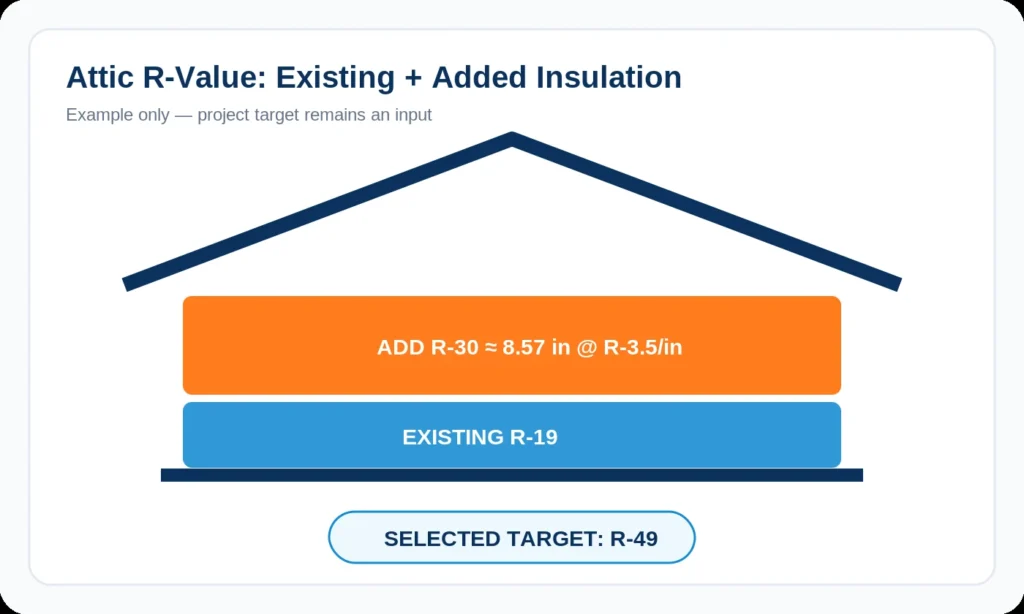
Attic insulation targets are usually discussed in R-values, but the correct target is not one universal number for every home. Climate, code, existing construction, energy goals and the location of the thermal boundary all matter. This guide explains how to convert a selected target into added insulation depth without pretending a calculator can choose the correct code requirement for you.
What is R-value?
R-value is a measure of resistance to heat flow. In general, a higher R-value means greater resistance to conductive heat flow. R-value is not the same as thickness: two materials can provide different R-values at the same thickness.
Why attic R-value recommendations vary
There is no single attic R-value that applies to every project. Climate zone, new vs existing construction, local energy code, existing insulation, assembly and energy goals can all affect the target.
ENERGY STAR consumer guidance gives R-38 as a common recommendation for many attics, but that should not be treated as a universal code value.
Existing R-value vs target R-value
Existing insulation: R-19
Selected target: R-49
Additional requirement: R-30
Convert the R-value shortfall to added thickness
30 ÷ 3.5 = 8.57 in of added thickness.
This is a nominal planning calculation. Actual installed performance depends on the product, density, installation quality, compression, voids and assembly conditions.
Example: 1,200 ft² attic
| Item | Value |
|---|---|
| Attic area | 1,200 ft² |
| Existing insulation | R-19 |
| Selected target | R-49 |
| R-value still needed | R-30 |
| Product planning value | R-3.5/in |
| Added thickness | ≈8.57 in |
| Added material volume | ≈857 ft³ |
The Attic Insulation Calculator performs this calculation while keeping the target and R-value per inch editable.
Air sealing should be addressed before adding attic insulation
ENERGY STAR recommends air sealing the attic before adding insulation. Common leakage paths can include wiring, plumbing, ducts, chimneys, top plates and attic access points. Insulation and air sealing solve different parts of the building-envelope problem.
Look for uneven insulation, not just average depth
An attic can have adequate depth in the center and still contain thin areas near eaves or obstructions. ENERGY STAR guidance notes that insulation should be evenly distributed without low spots.
Do not block intended ventilation paths with insulation. Baffles or rafter vents may be used where appropriate to preserve soffit-to-attic airflow.
Existing insulation type matters
Fiberglass, cellulose, mineral wool and other materials can have different performance. Do not infer R-value from depth alone unless the material and condition are reasonably known.
If several known insulation layers are present, the Insulation R-Value Calculator can combine their nominal values.
Special warning: vermiculite attic insulation
EPA recommends assuming vermiculite insulation may contain asbestos and leaving it undisturbed. Vermiculite is often loose and pebble-like and may appear gray-brown or silver-gold.
Blown-in insulation: use the coverage chart for the selected target
For blown-in cellulose or fiberglass, a bag’s coverage changes with installed condition. Use the product’s coverage chart at the intended R-value or installed depth/density.
Use the Blown-In Insulation Calculator with the actual label coverage instead of a generic bags-per-square-foot assumption.
Nominal R-value is not whole-assembly R-value
Adding nominal layer R-values is useful for planning, but real roof/ceiling assemblies include framing and other components. Thermal bridging, air leakage, gaps, compression, moisture and workmanship can reduce whole-assembly performance.
Common attic-insulation mistakes
- Assuming one R-value target applies everywhere.
- Using depth without knowing the material or R-value per inch.
- Adding insulation before major attic air leaks are addressed.
- Blocking soffit vents or other intended ventilation paths.
- Using generic blown-in coverage instead of the product chart.
- Disturbing suspect vermiculite insulation.
Which calculator should you use?
- Attic Insulation Calculator — existing R-value, target R-value, added depth and volume.
- Insulation R-Value Calculator — combine nominal layers and calculate a target shortfall.
- Blown-In Insulation Calculator — convert label coverage into bags, weight and optional cost.
- Insulation Calculator — broader area, thickness, volume and package planning.
- Insulation Calculators — browse the full cluster.
FAQ
What R-value should my attic have?
There is no one value for every home. Use the applicable local energy code or other project-specific guidance for your climate, assembly and project.
Is R-38 enough for an attic?
R-38 is commonly referenced in consumer guidance, but it is not universal. Some projects may use different targets based on climate, code, existing construction and energy goals.
Can I put new insulation over old insulation?
Often yes, but first evaluate the existing material, condition, moisture, contamination concerns, facings and installation requirements. ENERGY STAR notes that added attic insulation does not always have to match the existing material.
How many inches is R-49?
There is no single thickness because products have different R-values per inch. Divide 49 by the product-specific R-value per inch for a simple nominal estimate, or use the manufacturer’s depth/coverage chart.
Should I air seal before insulating?
ENERGY STAR recommends air sealing the attic before adding insulation so uncontrolled leakage is addressed while it is still accessible.
Sources and methodology
This guide uses BuildCalcForge’s transparent R-value and thickness relationships for planning. Reference guidance includes ENERGY STAR’s Adding Attic Insulation and Attic Insulation Project resources, U.S. Department of Energy building-science guidance on insulation and thermal envelopes, and U.S. EPA guidance on vermiculite insulation. Local code and manufacturer instructions control project-specific requirements.