
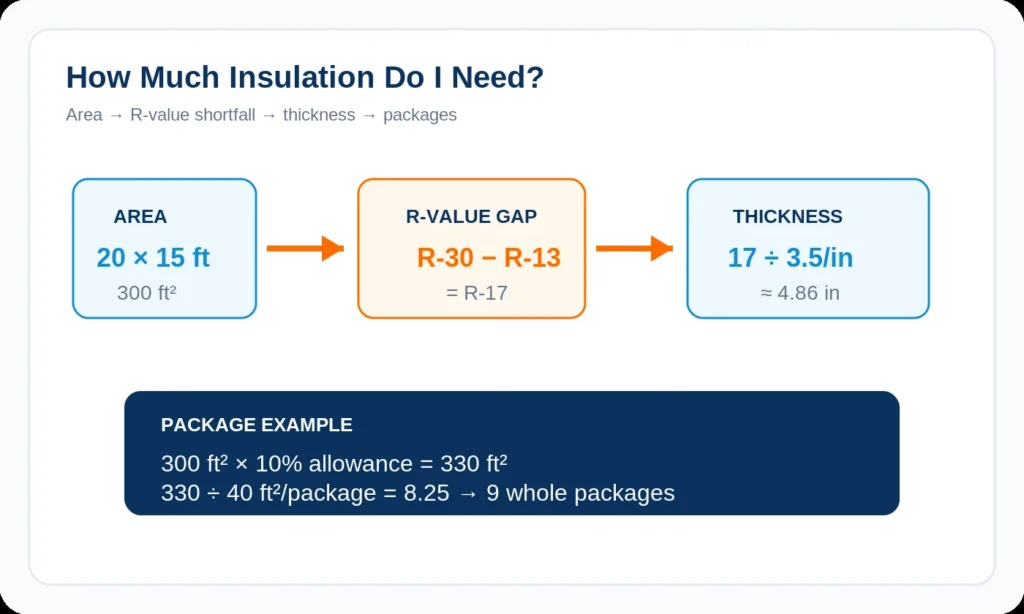
The amount of insulation you need depends on the area being insulated, the thermal resistance you want to add, and the actual performance or coverage of the product you plan to install. Keeping those inputs separate produces a better estimate than using square footage alone.
1. Measure the net area to be insulated
For a rectangular attic floor, wall or ceiling, begin with length × width. For several rectangles, calculate each area separately and add them together.
For walls, subtract doors and windows when your estimate is based on the insulated cavity area. For attics, do not automatically subtract every obstruction; penetrations may need air sealing or clearance rather than ordinary insulation coverage.
2. Determine how much R-value you need to add
R-value measures resistance to heat flow. If you know the existing nominal R-value and have selected a project target, the additional R-value is:
If the existing value meets or exceeds the target, the simple R-value shortfall is zero. That does not automatically mean the assembly has no air leakage, thermal bridging, compression, gaps or moisture problems.
3. Convert added R-value into insulation thickness
If product performance is expressed as R-value per inch, divide the additional R-value by that value.
17 ÷ 3.5 = 4.86 in of added thickness.
Use the product’s actual published data when available. Different products and densities can have different thermal performance.
4. Estimate insulation volume
For loose-fill or other applications where volume is useful for planning, multiply net area by thickness after converting the dimensions into compatible units.
For US units:
300 × 4.86 ÷ 12 ≈ 121.5 ft³.
5. Add a project allowance where appropriate
Some estimates include an allowance for cuts, irregular geometry, handling or coverage uncertainty. The suitable allowance depends on the material and installation method.
A 300 ft² area with a 10% planning allowance becomes 330 ft².
6. Convert area into packages
If a package covers a known number of square feet at the thickness or R-value you intend to install, divide adjusted area by package coverage and round up.
Round up to 9 packages.
For loose-fill insulation, do not assume that one bag covers the same area at every R-value. Coverage changes with installed thickness and density, so use the manufacturer’s coverage chart or bag label.
7. Blown-in insulation needs label-based coverage
The Blown-In Insulation Calculator is built around this label-based approach rather than a generic bags-per-1,000-ft² rule.
8. Attic projects: air sealing comes before simply adding more
ENERGY STAR recommends air sealing the attic before adding attic insulation. Insulation slows heat flow, while air sealing addresses uncontrolled air leakage through penetrations and gaps.
Use the Attic Insulation Calculator after selecting an existing and target R-value. The tool estimates added depth and volume from those inputs instead of choosing a target automatically.
9. Existing insulation is not always safe to disturb
EPA advises homeowners with vermiculite insulation to assume it may be asbestos-contaminated and to leave it undisturbed. Do not dig through or remove suspect vermiculite simply to obtain a measurement for a calculator.
Complete worked example
| Input | Example | Result |
|---|---|---|
| Area | 20 ft × 15 ft | 300 ft² |
| Existing R-value | R-13 | — |
| Target R-value | R-30 | R-17 additional |
| Planning performance | R-3.5 per inch | 4.86 in added thickness |
| Material volume | 300 ft² × 4.86 in | ≈121.5 ft³ |
| Allowance | 10% | 330 ft² adjusted area |
| Package coverage | 40 ft²/package | 9 whole packages |
Which BuildCalcForge insulation tool should you use?
- Insulation Calculator — broad area, R-value, thickness, volume and package planning.
- Attic Insulation Calculator — added attic R-value and depth.
- Blown-In Insulation Calculator — label-based bag count, coverage, weight and optional cost.
- Insulation R-Value Calculator — combine nominal insulation layers and calculate R-value shortfall.
- Insulation Calculators — browse the complete insulation collection.
Common insulation estimating mistakes
- Using square footage alone without the thermal target.
- Assuming every insulation product has the same R-value per inch.
- Using one blown-in bag coverage number at every target R-value.
- Ignoring existing insulation when calculating the added R-value.
- Adding attic insulation without addressing major air leakage first.
- Disturbing suspect old insulation simply to measure it.
FAQ
How do I calculate how much insulation I need?
Measure net area, determine the additional R-value required, convert it into product-specific thickness or coverage, apply an appropriate allowance, then convert the result into whole packages or bags using product data.
Can I calculate insulation from square footage alone?
No. Square footage gives area, but a useful estimate also needs the thermal target and the insulation product’s performance or coverage.
Do I need to remove existing insulation first?
Not necessarily. The correct approach depends on material, condition, moisture or contamination concerns, the assembly and the new product. Do not disturb suspect vermiculite insulation.
Should I use the same insulation type when adding more?
Not always. ENERGY STAR notes that additional attic insulation does not necessarily have to match the existing type, but product compatibility, facings, moisture control and installation details still matter.
Sources and methodology
BuildCalcForge uses transparent area, R-value, thickness and coverage relationships for planning. Reference guidance includes ENERGY STAR’s Adding Attic Insulation and Attic Insulation Project resources, U.S. Department of Energy building-science information on insulation and R-values, and U.S. EPA guidance for vermiculite attic insulation. Product-specific coverage and R-value data should come from the insulation manufacturer.